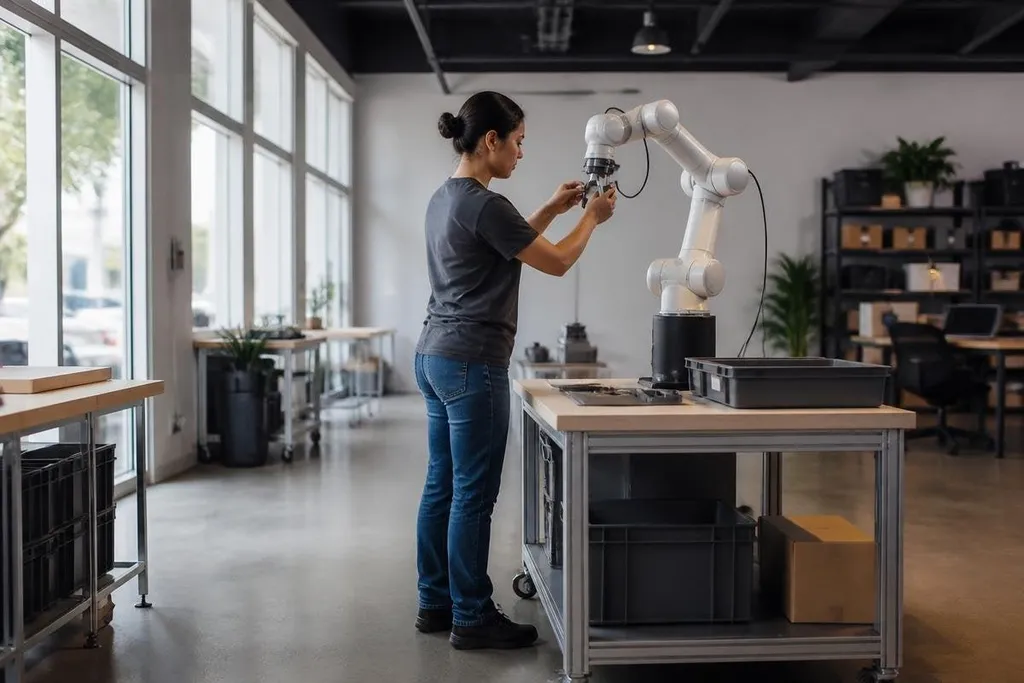
A robot can lower the cost of doing one paid task, but it won't create a business by itself. For a new founder, the useful question is narrower: which job can a robot perform well enough to sell, repeat, and support?
- Start with a paid task: Move goods, inspect equipment, clean floors, or collect site data.
- Charge for the result: Customers usually buy fewer damaged items, cleaner buildings, or faster inspections.
- Keep a human in the loop: Setup, repairs, safety checks, and customer service still need people.
The first change is access to equipment
Large companies can spread the cost of automation across many sites and shifts. A small firm has fewer orders, less spare cash, and less room for a machine that sits idle.
Lower robot prices could change that calculation. A founder might buy a small robot arm for packing, a mobile robot for indoor delivery, or a camera-equipped machine for inspection. The business case would still depend on the purchase price, repair cost, software fees, and the amount of paid work the robot can complete.
That shifts the starting point for a new company. Instead of hiring a large team before winning steady work, the founder could begin with one machine and add people around the tasks the robot cannot handle.
The machine needs a job before it needs a brand.
Service businesses may grow first
Selling a robot is only one path. A small company could buy a machine and sell the work it performs: floor cleaning, stock counting, crop monitoring, equipment checks, or simple material handling.
This model matters because customers may not want to own a robot. They may want a clean site, an inspection report, or goods moved between two points. The founder carries the burden of charging, maintenance, and training while the customer pays for an agreed service.
The service company also gives a founder more than one way to earn revenue. They could charge per visit, per inspected item, per operating hour, or through a regular service agreement.
Each method creates a different need for scheduling, repair planning, and proof that the work was done correctly.
A low robot price still leaves a founder paying for setup, repairs, and staff time. Reports at Robot24.com can put the machine, task, work site, and service needs beside that price, so the next hire starts with the work the robot actually requires.
Small teams will still need robot skills
Affordable hardware does not remove the need for technical work. Someone must map the operating area, set task limits, check sensor readings, update software, and respond when the robot stops.
That creates room for small firms that sell setup and support rather than physical products. A local technician could configure machines for several customers, keep spare parts, train staff, and check performance after installation.
The work may look closer to a service contractor than a traditional software startup. The founder needs a clear service area, a repair plan, insurance, and a way to prove that the robot works safely around people.
Safety also limits where a new business can begin. A robot moving boxes in a marked indoor area presents a different problem from a machine working near children, traffic, or heavy equipment. The task, site, and operating rules matter as much as the robot's price.
The business can fail before the robot does
A low purchase price can hide a poor business case. A machine may need frequent supervision, stop when lighting changes, or work only with a narrow set of objects. Those limits can consume the labor savings a founder expected.
The customer may also reject the service if the result is hard to check. A report from an inspection robot needs clear evidence. A cleaning robot needs a standard that a site manager can verify. Without that proof, the founder is selling a promise instead of a finished job.
The strongest early companies will likely choose narrow tasks. A robot that handles one repeatable job in one type of building may earn money sooner than a general machine asked to do many jobs badly.
A practical test for a new robot business
Before buying equipment, check the business in this order:
- Name the paid result: Write down what the customer receives and how they will judge it.
- Count human minutes: Include setup, supervision, charging, cleaning, repairs, and travel.
- Price the full machine cost: Add software, parts, training, insurance, and downtime to the purchase price.
- Test the work site: Check floors, lighting, objects, access routes, people, and safety rules.
- Set a failure plan: Decide who responds when the robot stops and how quickly the job must continue.
- Find repeat demand: Ask whether the same customer needs the task weekly, daily, or across several sites.
A founder does not need the cheapest robot. They need a machine whose limits fit a paid task and whose unsupervised hours do not decide the company's fate.
The first useful question for affordable robotics is still waiting at the customer's site: can this machine finish one repeatable job well enough for someone to pay for it again?